
Start With the Bedroom (And Save Your Sanity) A well-intentioned, field-tested, and sanity-saving guide for parents of teenagers
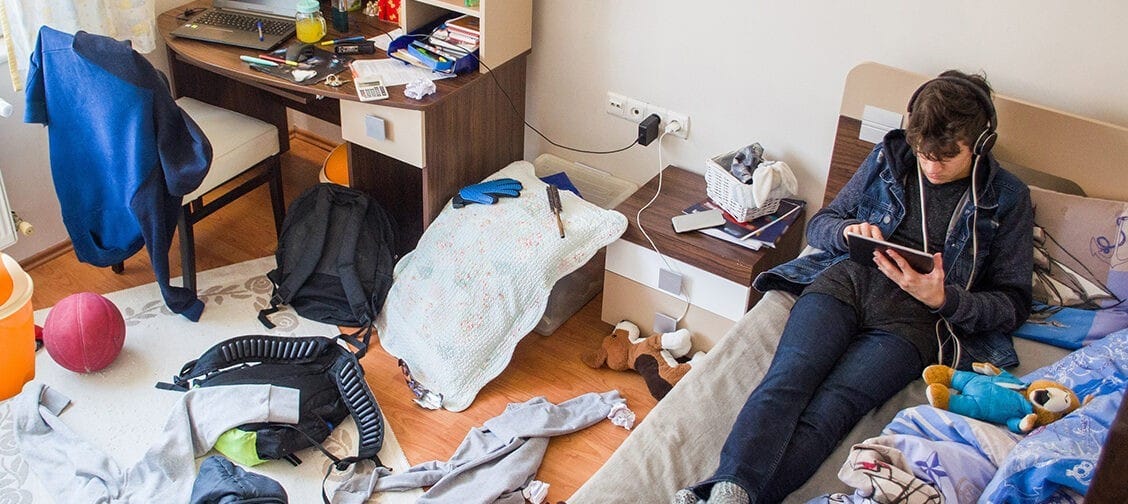
If you’ve ever walked into your teenager’s room and briefly wondered whether a new ecosystem might be forming there, you’re not alone. Dirty dishes, clothes in every possible state of matter, food remnants with a backstory of their own — for many families, this is as much a part of adolescence as acne and eye-rolling.
Let’s start with the good news: you didn’t do anything wrong. Messiness at this stage of life is not a sign of moral failure. It’s a remarkably reliable developmental feature.
Let’s talk expectations. Young children often love helping around the house. Some vacuum as if they’re on payroll, others sort toys with military precision. That does not mean, however, that they’re capable of maintaining order long-term. That skill is more complex than it looks. Exceptionally structured kids may manage it at nine or ten. On average, it develops around thirteen or fourteen. By sixteen or seventeen, all psychologically healthy teens can do it — they just often don’t see a compelling reason to.
The next stumbling block is the word “order” itself. Parents and teenagers almost never mean the same thing by it. While parents usually define order as a space that can be entered without protective gear, teenagers often operate by very different standards. That’s why order needs translation. Commands like “Clean up your room!” or “Get this place in order!” are well-meant — and almost entirely ineffective. What works better are specifics: “Nothing on the floor,” “Food stays in the kitchen,” or “Clean clothes live in the closet, not on the chair.”
Another classic mistake is lumping everything together. Personal order and household chores are two completely different things. A teenager’s room is their personal living space. Household chores are about shared life. Mixing the two reliably creates mental chaos — not just for the child, but for everyone involved.
Household chores are not activities anyone does for fun. Taking out the trash, mopping floors, grocery shopping. The key is this: tasks must be clear, age-appropriate, and unambiguous. And here comes the part that makes many parents nervous — once a task is assigned, no one else does it. Ever. If your teen is responsible for grocery shopping and forgets the potatoes, then there are no potatoes. Yes, it’s inconvenient. Yes, everyone suffers a little. And yes — this is exactly where learning happens.
When it comes to the teenager’s room, a simple (though not always calming) strategy works best. First, decide what you want. For example: no food in the room, nothing on the floor. Then communicate this calmly and clearly. Discussions are optional; results are not. Next comes the choice: “Will you take care of it, or should I?” If your teen says, “You do it,” respond kindly: “Sure.” And then do it — by your rules. Everything edible gets tossed. Everything on the floor goes with it. No drama. No commentary. No lectures.
In practice, rooms usually start looking noticeably emptier after just a few rounds. Teenagers, it turns out, develop a surprisingly refined sense of order at that point.
What doesn’t help are moral lectures. Statements like “No one will take you seriously later in life” or “When I was your age…” reliably trigger instant mental shutdown. Order isn’t learned through shame. It’s learned through consistency.
In short, no parenting magic is required. Just a few basics: know what you want. Say it clearly. Keep expectations age-appropriate. And follow through — even when it’s uncomfortable.
In the end, this isn’t about perfect rooms. It’s about responsibility. And responsibility doesn’t appear overnight. Sometimes, it’s born somewhere between a discarded plate and a missing sock.