
Gustav Klimt: The Man Who Gilded Anxiety (and remained remarkably true to himself)
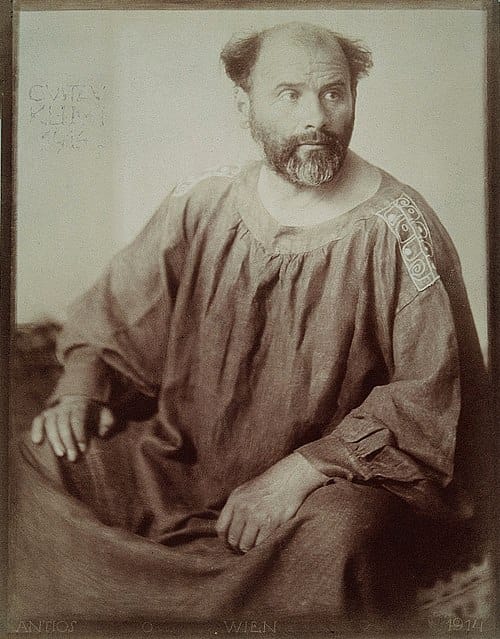
If Gustav Klimt were alive today, he would probably not have Instagram.
Or perhaps he would — but with a single image.
No caption.
Comments disabled.
And yet everyone would still spend hours discussing what he meant.
Klimt would have enjoyed that. Quietly. From a distance.
From model student to elegant dropout
Klimt began his career in a surprisingly conventional way. Academy training, discipline, commissions, recognition. Together with his brother Ernst and his friend Franz Matsch, he painted ceilings, staircases, and theatres — polished, correct, decorative.
He was successful.
And very likely, deeply bored.
At some point, he essentially said:
“Thank you, that will do.”
And walked away from the very system that had elevated him.
The founding of the Vienna Secession was not a dramatic scandal but a refined exit. No shouting, no public battles — just a clear statement: We will now do things our own way.
An anecdote: Klimt and the offended public
When Klimt painted three large works for the University of Vienna — Philosophy, Medicine, and Jurisprudence — expectations were high. People anticipated heroic allegories and reassuring symbolism.
What they received instead were naked bodies, uncertainty, and uncomfortable existential questions.
The reaction was swift: outrage.
Newspapers raged, professors protested, politicians distanced themselves.
Klimt’s response?
He later bought the paintings back himself.
And decided to never again accept public commissions.
That is not resentment.
That is self-respect.
Gold: a family inheritance with depth
Klimt’s famous gold did not come from nowhere. His father was a gold engraver, and as a child Gustav watched metal being shaped, polished, transformed.
But Klimt did not use gold to display wealth.
He used it to create distance.
Gold is surface.
Gold dazzles.
Gold protects.
Beneath it lie vulnerability, desire, fear, intimacy, uncertainty. Klimt understood something essential: if you attract people with brilliance, they will stay long enough to confront what makes them uneasy.
An anecdote: women who did not ask for explanations
Klimt had many models, many relationships, and many children — the exact number remains unknown. He never married.
He rarely spoke about emotions.
He painted them instead.
His women are not decorative. They know something.
And they seem entirely uninterested in explaining it.
This unsettled people.
And still does.
An insider detail: a surprisingly ascetic life
While his paintings radiate luxury, sensuality, and excess, Klimt himself lived almost ascetically. He wore loose, simple garments, cared little for possessions, avoided social obligations, and preferred working alone.
He surrounded himself with cats rather than people.
Which feels remarkably contemporary.
Love, Klimt-style: beautiful, but never safe
The Kiss is not a promise of eternal romance.
Look closely: the figures stand at the edge.
Almost at an abyss.
The embrace is intimate — and fragile.
For Klimt, love is never guaranteed.
It is a moment. Precious. Intense. Uncertain.
Why Klimt still speaks to us
Because he refuses simplification.
Because he does not explain.
Because he does not use beauty to reassure, but to invite attention.
He understood that human beings are contradictory.
And that this is not a flaw, but the point.
Klimt did not offer solutions.
He allowed complexity.
And gilded it.
What we can learn from him
That one does not need to be loud to be radical.
That it is permissible to set boundaries — even against expectations.
And that not everything that works needs to be explained.
Klimt does not invite admiration.
He invites us to stay.
And perhaps that is his greatest — and most modern — achievement.
Gustav Klimt – Biographical Facts
Full name: Gustav Klimt
Born: 14 July 1862, Baumgarten near Vienna, Austria
Died: 6 February 1918, Vienna
Period: Viennese Modernism, Symbolism, Art Nouveau
Known for:
– Co-founder of the Vienna Secession
– The Kiss
– Adele Bloch-Bauer I
– His Golden Phase
Notable facts:
– Rejected public commissions after early scandals
– Lived reclusively and worked mostly alone
– Rarely explained his art, allowing it to speak for itself
